
Venue: Rotunda Theatre, George Heriot’s School (Venue 65)
Date seen: 13 August 2026
Running until: 23 August 2026
Reviewed by: Anonymous
Rating: ★★★ 3/5
As background, this production is a new work created and performed by a number of non-actor graduate students from Cambridge. This is apparently a debut effort for all involved.
Kudos to the creative team and entire cast for the monumental effort of creating and performing this work. Unfortunately, the show we saw on the night of August 13 was plagued with audio problems, with severe feedback causing distortion of the musical numbers and the actors’ monologues. This made it difficult to understand the text and context of what the work was trying to accomplish and communicate.
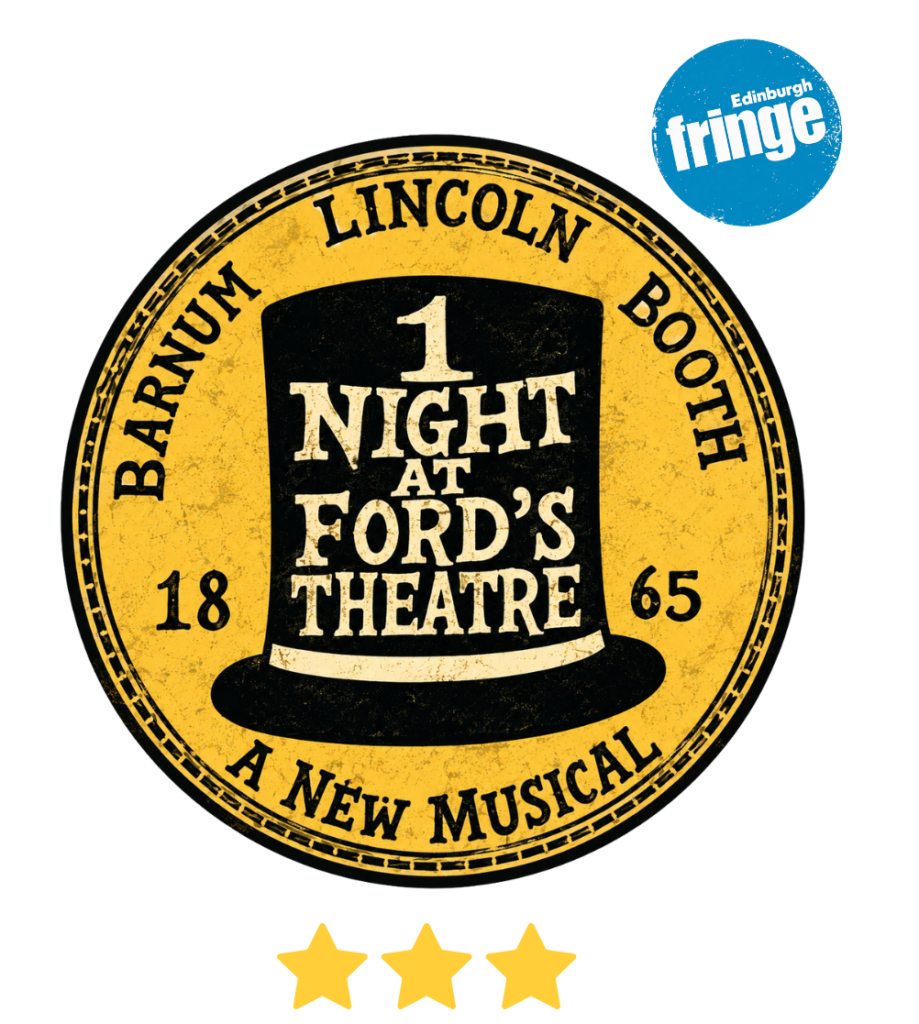
There was certainly a lot going on at the same time for the audience to try to track and keep up with, made worse by the bad sound system. The story of the Booth brothers, John Wilkes and Edwin, is told through the narration of the character P. T. Barnum, a circus master used as the mechanism to introduce the plot to the audience and then tell the timeline leading up to Lincoln’s assassination.
There is an effort to explain how John Wilkes Booth became an assassin by showing him as the least talented of a family of actors, resulting in his general resentment and animosity towards the world. The script does this by exploring the family dynamics within the Booth family, with an actor father, the favoured and talented son Edwin, and the less talented and resentful John Wilkes.
Apparently, John Wilkes was sent to the South, where he became sympathetic to slave owners. The play provides numerous recitations by these characters of the murder scenes from Hamlet, both as foreshadowing and “past as prologue”. The fullest explanation of a character is the development of John Wilkes Booth’s motivation to kill Lincoln through his repeated statements that “all tyrants must die”, which, in my mind, came perilously close to a rationalisation and justification of Lincoln’s murder.
Lastly, the play begins and ends with an intoned monologue about memory and history as a dream, which I noted but did not understand in the context of the plot.
I could see the hard work of all involved manifested on the stage, but unfortunately, for me, the “noise” of the multiple threads of the presentation, as described above, obscured any clear “signal” or message of the work. This was certainly made worse by the sound system undermining the actors’ hard work. Hearty, well-trained belt voices would have served this show well. I especially appreciated the efforts of Will Rowse as John Wilkes Booth, Summer Beechey as Edwin Booth and Munya Mundove as Abraham Lincoln.
After the performance, I was asked by the playwright if I had any suggestions and was told that the script had just been revised to focus on why John Wilkes Booth was angry, rather than focusing on the relationship between the brothers. My only thought would be to more clearly choose a plotline and fully develop the characters accordingly. Is this a story of John Wilkes Booth, or of the Booth brothers choosing different paths and why, or not? Is it about our collective memories of history being wrong?
So, if you choose this play, the creative team is apparently open to your feedback and suggestions to better develop this worthy work in progress. Due to the bad sound system and my own difficulty in tracking a fully developed theme or character, I struggled with this particular presentation.
★★★