
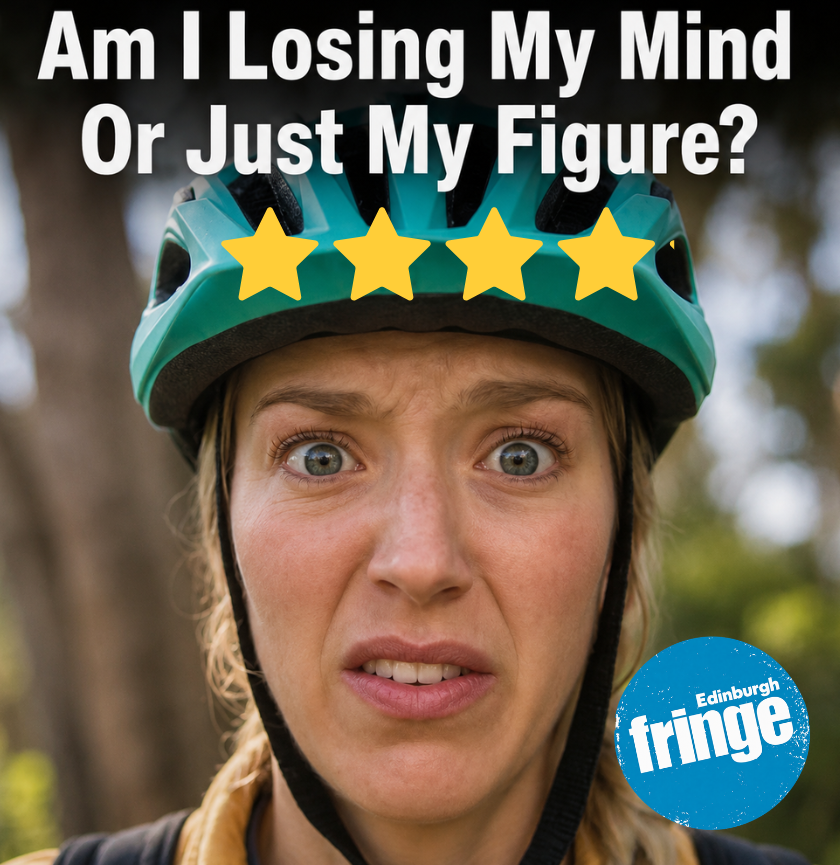

Am I Losing My Mind or Just My Figure?
Performer: Genevieve Labuschagne
Venue: Playground 1 at ZOO Playground
Date and time: Saturday 15th August, 12:45pm
Ticket price: £14.50
Reviewed by: Sarah Turnbull
Rating: ★★★★ 4/5
Am I Losing My Mind or Just My Figure? is serious theatre in the best sense: spare, precise and emotionally exact. It gives you one performer, a handful of objects and a story that refuses to tidy away the contradictions of early adulthood, pregnancy and loss. I’ll admit it wasn’t what I was expecting; the piece takes a heartbreaking turn I didn’t see coming, and yet (spoiler) it finds its way to a genuinely happy ending.
We meet Fin, a freelance illustrator piecing together a living on a zero-hour contract as a cycle courier. She’s free-spirited, unconventional and largely unbothered by the milestones her peers are ticking off. When she discovers she’s pregnant, the world doesn’t collapse so much as tilt. The play tracks that tilt with candour: Fin tests her own beliefs against the expectations pressing in – family, faith, partners, friends – including a pushy mother and a pushover father whose love comes tangled with prescription and silence, and, crucially, against the casual othering that can descend the moment a woman is seen as “expectant”.
It’s about choice, yes, but also about how a life gets narrated for you the second your body becomes public property.
The staging is deliberately lean. A stool becomes a bike, a bed, a waiting room chair. A rail of clothes hints at the other roles Fin is forever being asked to put on. There are brief, effective appearances from illustrations – sometimes projected, sometimes literally handled – that step in as extra characters or visual asides. In them, the parents are drawn with economical clarity: mum brisk and rule-bound, nudging; dad amiable and avoidant, coughing non-answers.
Three-quarters of the way through, I realised something that sounds obvious on paper but didn’t register in the room: there is no score underpinning this, no sound effects, no sonic scaffolding at all. Just one person speaking. I hadn’t clocked the silence because the storytelling is so full – full of thought, wit, breath, the small frictions of daily life. That absence of adornment is a statement in itself.
Labuschagne’s performance is the reason it works. The detail is exquisite. A nervous twitch appears on cue and is mastered just as deliberately; a half-laugh collapses into a glance you can feel in your own throat. She can turn on a pin from buoyant to brittle, and when the play’s pivot arrives – sudden, devastating – the drop is handled without sentimentality.
What follows is a passage of raw grief – spare, unvarnished, almost matter-of-fact in its honesty – that the room meets with held breath. It is not pretty, and it is not staged to be: you hear the air leave the space, shoulders shake, and more than a few of us are in tears. It is properly felt. And crucially, the play doesn’t leave us there; it threads its way back to light with integrity, earning a hopeful, happy ending without softening what came before.
What lingers is the integrity. This is a quietly powerful collaboration – a performer in control of her craft, a text that knows exactly what it’s doing, and a production that resists the urge to gild. Moving without manipulation, rigorous without chill, it’s a solid, affecting piece of theatre – and a reminder of what a single body on a stage, and the courage to keep things simple, can do.
★★★★